
Helsinki, EMTA’s next General Meeting host, has launched a new tram route across its maritime landscape, connecting the city centre with Laajasalo, Helsinki’s largest island. Travelling across the Crown Bridges, passengers can now enjoy panoramic views of the Baltic Sea, Helsinki’s archipelago and the city skyline. The new connection is also an internationally exceptional example of large-scale bridge infrastructure designed exclusively for public transport, pedestrians and cyclists, reflecting Helsinki’s commitment to people-centred urban planning and bringing nature closer to everyday urban life.
Helsinki’s urban landscape has undergone a significant transformation with the completion of the Crown Bridges, connecting the Hakaniemi neighbourhood with Laajasalo via a series of three bridges. Construction began in 2021, and the landmark Kruunuvuorensilta Bridge opened to pedestrians and cyclists in April 2026. On Saturday, 7 November, two new tram lines, 11 and 12, began operating across the bridges, introducing one of Helsinki’s most scenic public transport journeys. The opening of the new routes was celebrated over the weekend.
The island of Laajasalo lies to the east of central Helsinki, separated from the city centre by a stretch of sea. With the completion of the Crown Bridges, the distance between Kruunuvuorenranta and central Helsinki has been reduced from approximately 11 kilometres to 5.5 kilometres. The new connection also significantly reduces travel times, with the journey between Laajasalo’s Yliskylä neighbourhood and the city centre now taking approximately 20 minutes by tram.
“The opening of these two new tram lines marks a historic moment for Helsinki. What used to be separated by a stretch of sea is now just a 20-minute tram ride away. The Crown Bridges not only bring the city centre closer to the residents of Laajasalo and Kruunuvuorenranta, but also open new opportunities for residents and visitors alike to discover Helsinki’s unique maritime landscape and archipelago. The new tram route offers a completely new perspective on the city, with spectacular views of the sea and surrounding islands,” says the Mayor of Helsinki, Daniel Sazonov.
The three bridges span approximately 1,931 metres altogether, with the longest, Kruunuvuorensilta, measuring 1,191 metres, making it Finland’s longest bridge. Its distinctive diamond-shaped pylon rises 135 metres above sea level, one metre taller than Helsinki’s tallest residential building, Majakka, which stands at 134 metres. From the bridge, passengers can admire sweeping views towards the open sea, Suomenlinna Sea Fortress and Helsinki’s eastern coastline.

A City of Islands
With 327 islands within its borders, Helsinki boasts a remarkably extensive archipelago for a capital city, making the sea and its islands an integral part of the city’s landscape and identity. The Crown Bridges project strengthens connections to Helsinki’s largest island, Laajasalo, whose population is expected to double by 2040. The new tram connections provide frequent, reliable and faster public transport to support the island’s growing population.
Laajasalo offers extensive coastal landscapes, peaceful natural areas and scenic viewpoints overlooking central Helsinki. Strengthening connections to the island not only benefits local residents but also makes its many recreational opportunities and nature destinations more accessible to visitors.
For People, Not Cars
The districts of Kalasatama and Kruunuvuorenranta are relatively new waterfront neighbourhoods, both directly served by the new tram connections. From the outset, their planning has prioritised public transport, walking and cycling over private car traffic. Today, the majority of journeys in Helsinki are made using sustainable modes of transport: approximately 41% on foot, 25% by public transport and 11% by bicycle, while only around 20% are made by car.
Walking through Kalasatama and Kruunuvuorenranta, visitors will notice wide, two-way cycle paths, generous pedestrian areas and inviting waterfront spaces. Especially during the summer months, the neighbourhoods come alive with pedestrians and cyclists enjoying the sea views and peaceful streets.
The new tram routes extend this people-centred approach across the sea, making Helsinki’s islands and waterfront neighbourhoods an increasingly integrated part of everyday city life.
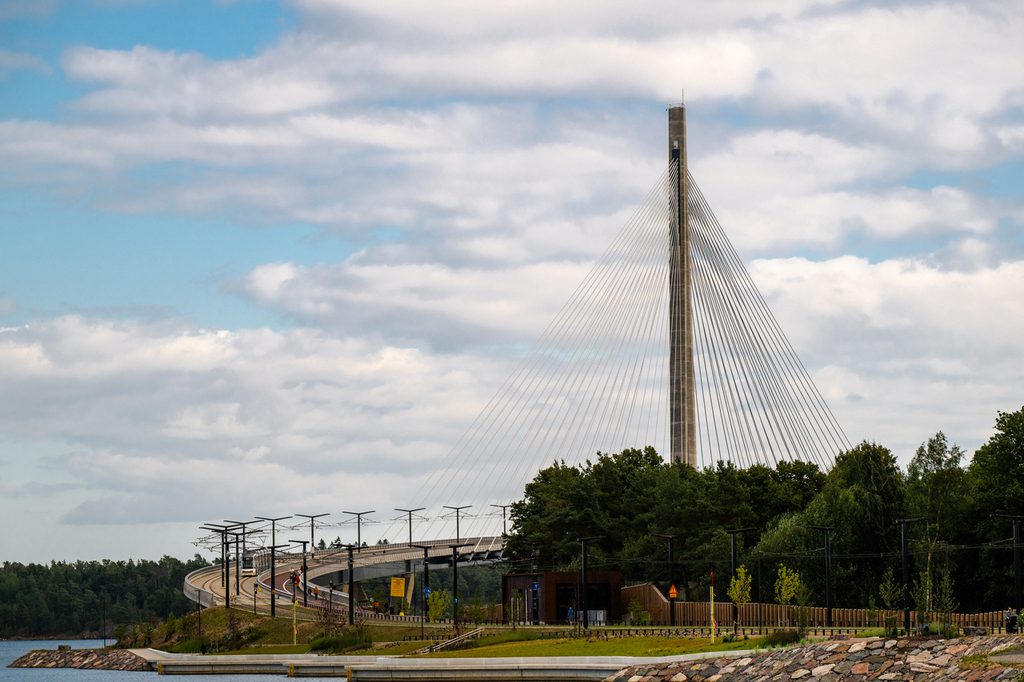
Fact Box – Kruunuvuorensilta Bridge
Design competition organised: 2012
Construction started: 2021
Main designer: WSP Finland, Sami Niemelä
Bridge architecture: Knight Architects / Bridge Architecture
Engineer: WSP Finland
Contractor: YIT / Kreate JV
Contractor’s engineer: Ramboll
Alliance partners: City of Helsinki, Kaupunkiliikenne Oy, YIT Infra Oy, NRC Group Finland Oy, Ramboll Finland Oy, Sweco Finland Oy, Sitowise Oy
Project management: HTJ
Estimated cost: Approximately €326 million (Crown Bridges Light Rail project, including all three bridges between Laajasalo and Hakaniemi; estimate from December 2020)
Tram speed: Up to 60 km/h on the Kruunuvuorensilta Bridge section
Projected usage (2030):
- Approximately 23,000 daily tram trips
- Approximately 3,750 daily cycling trips across the bridge
Distance reduction: From approximately 11 km to 5.5 km between Kruunuvuorenranta and the city centre